A Seat At The Table
Notes from Menorca: Chapter 4
Reflections on regenerative farming, slow travel, and finding the hidden gifts in life's unexpected turns.
Son Blanc Farmhouse, Menorca, Spain
* * *
Sometimes we think we're searching for a place to belong.
Sometimes we're searching for the people who make us feel like we already do.
And sometimes, in sharing food, stories, and dreams around a table, we remember the kind of life we wanted to create all along.
* * *
After my first stressful week at Son Blanc, when I had nearly called it quits on my seventh day, in walked Cat.
A Louisiana girl with auburn hair, pale freckled skin, and a big smile, Cat had just returned from a weeklong vacation with her family. Unlike me, she was happy to be back at Son Blanc—and, perhaps more importantly, happy to be on her own again.
Cat had been living outside of the United States for more than ten years. She had recently spent two years in Barcelona, which she described as a good “landing place” in Spain, and was now in Menorca finishing the last month of her culinary program through an internship at Son Blanc.
She mostly worked in the restaurant kitchen, but several times a week she would come down to the barn where I lived and worked to spend time in the “dispensary,” a storage room filled with preserved and pickled vegetables, homemade jams, olives, and all kinds of beautiful things grown on the farm.
I realize that calling it a barn probably creates the wrong image.
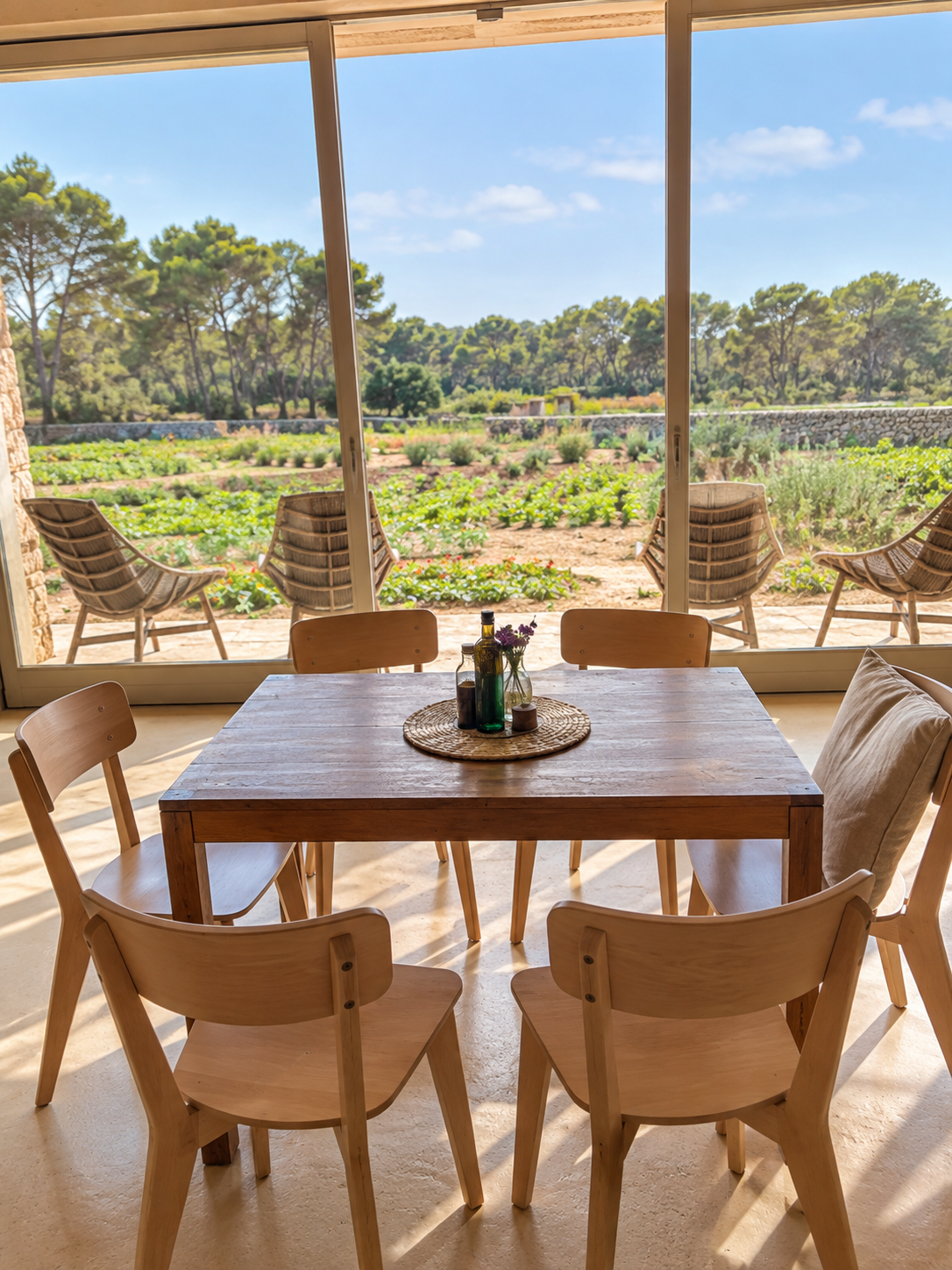
The barn at Son Blanc was new and modern, built with the same stone as the hotel and restaurant, with enormous floor-to-ceiling windows overlooking what I still believe was the best view on the property: the farm.
From those windows were neat rows of tomatoes in every color and size, cucumbers, peppers, sunflowers, carrots, strawberries, pumpkins, onions, sweet potatoes, watermelons, basil, zucchini and melons. Flowers appeared everywhere, sometimes in little fields of their own, while vegetables crawled along the ground or climbed rows of tipi trellises. Beyond them were fruit and olive trees, the greenhouse, chickens, donkeys, sheep and herbs.
It was an absurdly beautiful place to be having such a difficult time.
And then Cat showed up.
I remember how comforting it felt simply to speak English.
After a week of communicating almost entirely in Spanish—while exhausted, overheated and trying to understand several different accents and dialects—having an effortless conversation felt like a small luxury.
Cat and I hit it off immediately.
It didn't take long before we were exchanging stories about Son Blanc, the brutal heat, the lack of air conditioning and the personalities we'd encountered along the way. She understood why I couldn't sleep. She understood how physically depleted I felt. She understood my frustration with trying to perform laborious farm work without eating enough protein to sustain it.
Mostly, she made me feel like I wasn't imagining how hard some of this had been.
Then, without hesitation, she offered me a place to stay.
On the weekends, I could come home with her, sleep in an air-conditioned apartment, catch up on rest and explore Menorca with her.
I don't think she had to ask me twice.
I like to joke that Cat helped me finally have a “proper holiday”—two American girls vacationing in Europe, after all.
And she did.
But first, she fed me.
Or maybe we fed each other.
Food became one of the languages of our friendship.
Cat and I had remarkably similar tastes. We both loved tofu. We both liked spicy food. Somehow, without much planning, we would each begin preparing a couple of things and eventually combine everything into the perfect bowl.
Her kitchen was tiny, but we moved around each other as though we'd been cooking together for years.
One of us chopped while the other washed. Someone reached for a pan while the other stepped aside. A cutting board disappeared into the sink and came back clean. Something simmered. Something got seasoned. Dishes were washed almost as quickly as we dirtied them.
Cooking with Cat felt like a friendship dance.
There was no need for one of us to make the entire meal. We each brought something to it.
I've always known that food is one of the ways I love people. It's part of why I care so deeply about teaching people to grow it. Growing food isn't just about producing tomatoes or herbs or having something healthy to eat. Food gives us a reason to gather. To feed someone. To sit down. To slow down. To share something we grew or made with our own hands.
Some of life's simplest moments happen around food.
And sometimes, so do the profound ones.
One evening, Cat and I were invited to experience Son Blanc differently. Not as workers, but as guests.
We got dressed up and attended one of the hotel's communal dinners, hosted by a special guest who was a writer and former chef. He had created an organization centered around something that, admittedly, doesn't sound like obvious dinner-party material:
Death.
He hosts “death dinner parties.”
The idea is to remove some of the taboo around talking about death and instead use our awareness of mortality to better understand life—our relationships, cultures, childhoods, beliefs, fears and the things that make us human.
There were about fourteen of us at dinner, divided between two tables. Cat and I sat with two couples and our host.
We didn't know these people.
That wouldn't last long.
The host explained our first prompt. We would each think of someone we had lost, light a candle for that person, and offer a short eulogy: who they were, what they meant to us, and how they had shaped our lives.
I knew immediately who mine would be.
Before I'd even really thought about what I was doing, I reached for a candle and lit it.
“Oh great,” the host said. “You'll start.”
Apparently, I had just volunteered myself.
I looked at the little flame in front of me and began talking about my Tío Victor.
My uncle had already been traveling through Menorca with me in a way. Memories of him had surfaced while I was there, particularly memories tied to language, family and my own complicated relationship with Spain.
And now, on this little Mediterranean island, I was introducing him to a table full of strangers.
I told them about the role he had played in my life.
And when I finished, everyone raised their glasses to him.
To Tío Victor.
Something shifted at that table.
One by one, another candle was lit. Another name spoken. Another person brought briefly back into the room through someone who loved them.
And we listened.
That first exercise somehow gave us permission to skip all the polite conversations strangers usually have when they meet.
We weren't talking about what we did for work or where we were from.
We were talking about grief.
Love.
Family.
Mortality.
Life.
Throughout dinner, our host offered other questions for us to explore. If you knew you had only twenty-four hours left to live, how would you spend them? Who would you spend them with? What would happen to your body after you died? Had you ever actually told the people you love what you wanted?
The conversations unfolded organically between courses.
We ate fresh food from the farm served on charcuterie boards, drank local wine and told pieces of our lives to people we'd met only hours before.
Charcuterie boards, incidentally, are exactly how I love feeding people when I host at home.
Of course they are.
By the end of the evening, the people sitting around that table didn't feel like strangers anymore.
We had different backgrounds, different cultures, different families and different beliefs, but death had made all of us equal. Every person at that table had lost someone. Every person loved someone they would eventually lose. Every one of us knew, whether we liked acknowledging it or not, that our own time was limited too.
And somehow that wasn't depressing.
It was freeing.
I think everyone left that table changed.
I know I did.
Maybe that's what a good table can do.
It doesn't have to solve anything. It simply creates a place for people to show up, eat, listen, tell the truth and recognize themselves in someone they might otherwise have assumed was completely different.
I had another table at Son Blanc, though I didn't understand its significance at the time.
Every day during our break, the farm team would gather around a simple wooden table in the barn to eat. We shared food, stories, complaints, jokes and a lot of laughter there. Those breaks became some of my favorite moments on the farm.
For most of my stay, the table had been tucked into a corner of the room. Then one day, another WWOOFer and I decided to move it. We centered it directly in front of the barn's enormous sliding glass doors, facing the farm.
Suddenly, there it was.
The garden we'd spent our days sweating over stretched out in front of us while we ate—the rows of vegetables, flowers and trellises we'd been planting, watering, weeding and harvesting in that relentless Menorcan heat.
We had been working so hard to sustain this beautiful place that somehow we hadn't been allowing ourselves to sit down and enjoy it.
So we moved the table.
I didn't know then that it would be my last day working at Son Blanc.
And I certainly didn't know that weeks later, back home, I would look at a photograph of that table and understand why the memory meant so much to me.
For one afternoon, we gave ourselves a better seat at something we had helped create.
The rest of my time with Cat wasn't quite so philosophical.
Mostly, we went to the beach.
Menorcans take beachgoing very seriously. If you have a day off, you go to the beach.
No excuses.
So Cat and I adopted the local custom with great enthusiasm.
Her apartment was only about a five-minute walk from what became my favorite cala, a tiny turquoise cove beside a beautiful cave that had been transformed into a lively bar. There, Cat introduced me to another Menorcan tradition: the pomada.
Gin and lemonade.
I had tried gin once in college and decided I didn't like it. Menorcan gin changed my mind. It was aromatic and herbal, which obviously appealed to the herbalist in me, and when blended with lemonade into a frozen slushy during a record-breaking European heat wave?
Listen.
I had suffered enough.
Cat and I drank many pomadas.
We also made it our mission to see as many beaches as possible. Nearly every day brought another cala, and somehow Menorca never disappointed us. Every beach seemed impossibly beautiful in its own way.
Because you can drive from one end of the island to the other in about forty-five minutes, we also explored different towns whenever we could. We'd walk through their central areas, shop, eat and find little restaurants and bars—some inside caves, some tucked into gardens, others sitting right along the water.
We ate a lot.
We drank a lot.
We walked a lot.
And one night, two American girls who had spent the day swimming in turquoise Mediterranean water found ourselves rocking out at a show by a local political punk band.
As one does in Menorca.
Toward the end of my stay, Cat and I decided we wanted something permanent to remember this strange little chapter of our lives.
Tattoos.
Cat chose a tiny carrot inspired by a photo she'd taken of one of the particularly funky-looking carrots we'd harvested at the farm.
I chose a tiny handheld fan.
Naturally.
Inside my little fan is Menorca: a cala, a beach cave, the ocean, a sailboat, the sun and seagulls overhead.
After surviving that heat wave, it felt appropriate that Menorca would permanently live on my body inside a fan.
One of our adventures together, though, planted a different kind of seed.
Cat and I visited Menorca's only mushroom-growing company, a family business started almost accidentally by a father and his two college-aged sons. Growing mushrooms had begun as a hobby. But as they learned more, they realized how little many people on the island knew about the more than one hundred varieties of mushrooms growing around them—or about their nutritional and culinary possibilities.
So they started teaching.
What began as a hobby grew into a facility where people could come learn about mushrooms and how to grow and use them. Eventually, they added a restaurant and began inviting local chefs to teach people the seemingly endless ways mushrooms could become part of a meal.
Cat and I were fascinated.
Our tour guide was one of the sons, and as he talked about how their family business had grown, both of us started taking notes. What seemed to matter most to them wasn't keeping their knowledge to themselves. Their success had come, in part, from sharing it—helping their community understand what was already growing around them and giving people practical ways to incorporate it into healthier lives.
Cat and I looked at each other and recognized something.
This.
This was the kind of work we wanted to create.
Not necessarily mushrooms. Not necessarily Menorca.
But a business that could grow food, teach people, feed them, bring other people's talents into the space and strengthen a community in the process.
Somewhere between our beach days, tiny kitchen meals, coffee and weed breaks, neighborhood walks, drinks and tapas, mushroom notes, tattoos and long conversations, Cat gave me something else to take home.
She reminded me of a dream I had almost forgotten.
Cat wants to become an entrepreneur. One day, she dreams of owning a hotel with a restaurant and a farm—something inspired in part by Son Blanc, but distinctly hers.
And she wants to run it with her friends.
She told me she'd actually been keeping a mental list of people in her life and the different talents they could bring to this future place.
Someone could contribute this.
Another friend would be perfect for that.
Everyone wouldn't have to do everything. They could bring what they were good at and create something together.
The idea was so simple and so brilliant that I immediately felt a little ridiculous.
How had I never thought of that?
Before coming to Menorca, I had been struggling to understand why I felt increasingly unmotivated by my own garden business.
I love growing food.
I love teaching.
I love helping people reconnect with the land and understand that growing food and medicine is something we all deserve access to.
So why had something I cared about so deeply begun to feel so heavy?
I had been carrying this quiet fear that perhaps I'd chosen the wrong path.
But sitting with Cat, listening to her describe her dream, another possibility occurred to me.
Maybe I didn't want to do it alone.
In fact, I never had.
I had always imagined my work becoming something my family could be part of someday. Yet in the meantime, I had been trying to figure out how to offer everything myself.
Gardener.
Educator.
Herbalist.
Host.
Business owner.
Community builder.
How many hats was I planning to fit on one head?
And suddenly I remembered another dream.
For years, I've imagined creating a bed-and-breakfast or retreat centered around sustainable living. A place where people could experience living smaller, perhaps in tiny homes; eat fresh organic food grown right outside; attend workshops centered around gardening, wellness and sustainable living; and share space with people from different backgrounds.
A community hub.
Somewhere people could learn ways of living that are healthier for themselves, their communities and the planet.
I had always been searching for that kind of community.
Maybe I was supposed to create it.
But creating it didn't mean I had to be all of it.
Maybe I could wear the hats that actually fit me and leave room for other people to wear theirs.
I thought again about Cat's tiny kitchen.
Two people moving around one another.
Each making something different.
Neither responsible for the entire meal.
And somehow, when everything came together, we had exactly what we needed.
Community has always been what drives me.
Perhaps I had become so focused on building a business that I'd forgotten I was really trying to build a table.
On my final night with Cat, we went to dinner and later met our new friend Marta, one of Son Blanc's chefs and a secretly brilliant painter, for our final drinks together.
Eventually, it was time to say goodbye.
My morning would begin at 5 a.m., and there was no way I was waking Cat at that ungodly hour just so we could have a dramatic farewell.
So we hugged that night.
I was sad, of course.
But strangely, I wasn't worried.
Some friendships feel temporary even while you're in them. They belong to a job, a city, a particular season of your life.
This didn't feel like that.
I had faith that Cat and I would remain friends.
And we have.
We've continued checking in on one another since leaving Menorca. Inspired partly by my own WWOOFing adventure, Cat went on to WWOOF in England and New York. And we've already played around with the idea of WWOOFing somewhere together next summer.
Maybe we'll do it.
Maybe we won't.
Maybe we'll spend years trading ideas and lessons as each of us figures out how to create these sustainable places we've been dreaming about.
I don't know yet.
But I like imagining that somewhere in the future there might be another farm, another tiny kitchen, another table.
And maybe Cat and I will find ourselves moving around each other again, making entirely different things and somehow creating the perfect meal.
Menorca taught me a lot about what I can endure.
Cat reminded me that I don't always have to endure things alone.
Sometimes someone pulls up a chair.
Sometimes you pull one out for them.
Sometimes you light a candle for someone who is no longer here, and a table full of strangers raises a glass to their life.
And sometimes, somewhere between growing the food, preparing it and passing the plates around, you remember what you were trying to grow all along.
A place for people to belong.
🌱 Seeds I Took Home
Community is something we cultivate.
The spaces where we feel most connected don't always exist waiting for us. Sometimes we have to create them—by pulling up a chair, sharing what we have, and making room for what others bring.
Food is more than nourishment.
Growing it, preparing it, and sharing it creates opportunities for connection. Some of the most meaningful conversations of my life have happened around a table.I don't have to wear every hat.
Creating something doesn't mean doing everything myself. Collaboration allows each person to contribute what they do best—and sometimes what we create together is better because no one person made the whole meal.Knowledge grows when we share it.
Whether teaching someone to grow food, introducing a community to the mushrooms growing around them, or inviting a chef to share what they know, education can be an act of community care.The right friendships can remind us who we are.
Cat didn't give me a new dream. She helped me remember one I'd already been carrying—and showed me another way it might be possible.Sometimes we need to enjoy what we're working so hard to grow.
We moved a table so we could finally see the farm we'd spent our days tending. I want to remember to do that more often: sit down, look around, and appreciate what is already growing.There is always room at the table.
For a new friend. For a stranger. For someone we've lost. For another person's story, talent, food, grief, laughter, or dream. Community begins when we make room for one another.